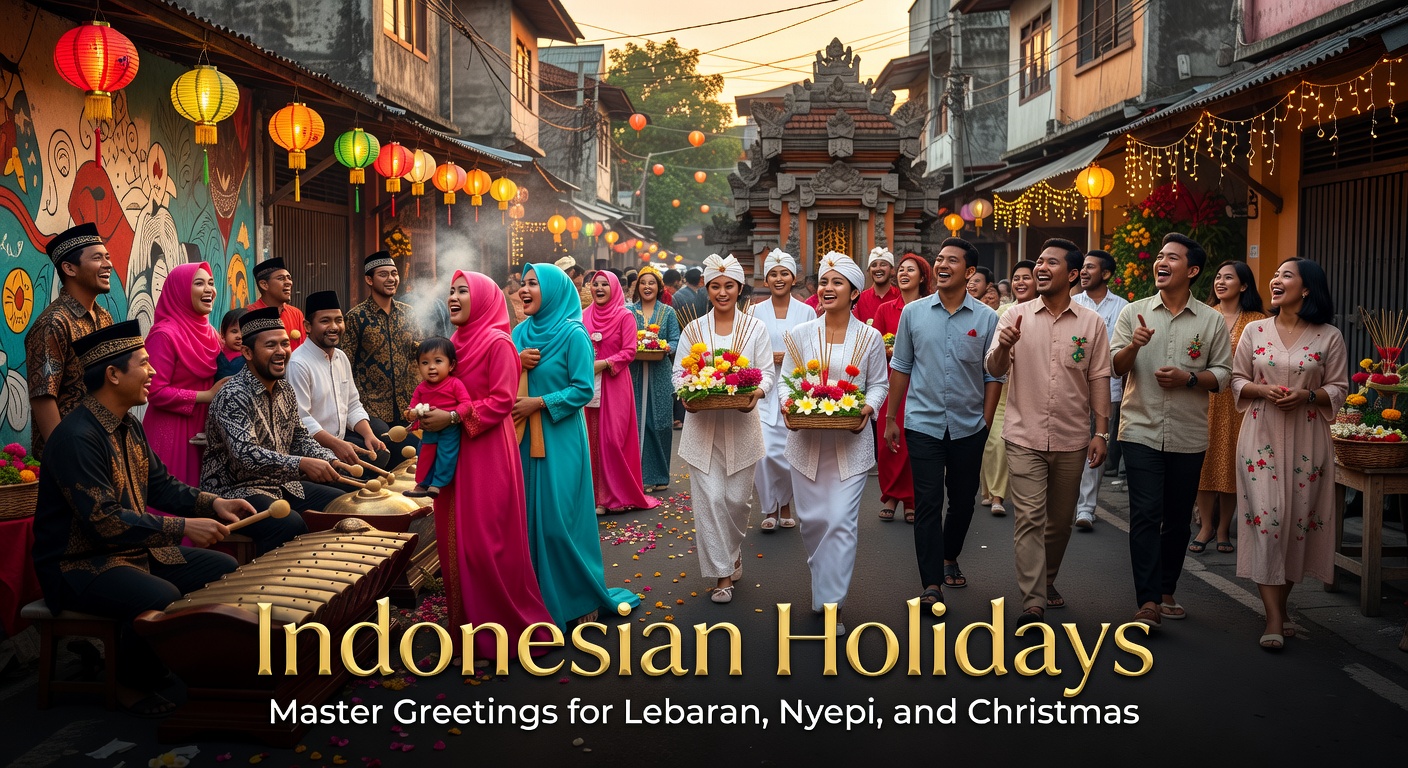
Indonesian Holidays: What to Say During Lebaran, Nyepi, and Christmas
Indonesia officially recognizes six religions and celebrates holidays from all of them. In a single month, your neighborhood might buzz with a Muslim holiday, a Hindu ceremony, and a Christian feast — sometimes all on the same street. This vibrant mix reflects Indonesia's incredible diversity, with over 1,300 ethnic groups and a motto of "Bhinneka Tunggal Ika" (Unity in Diversity). As an English speaker learning Bahasa Indonesia, mastering holiday greetings isn't just about vocabulary; it's a gateway to building genuine connections and showing respect in everyday interactions. Imagine striking up a conversation with your local warung owner during Lebaran or joining a Balinese family for Nyepi — these moments can turn language learning into lifelong memories.
Knowing the right phrases can make you feel like a true part of the community, and it's easier than you think with a bit of practice. In this guide, we'll dive deeper into the major holidays, complete with pronunciation tips, cultural insights, and practical advice to help you navigate these celebrations confidently. Plus, we'll sprinkle in some internal links to our lessons, like Lesson 2.4 on cultural etiquette, to keep your learning journey flowing smoothly.
Lebaran / Idul Fitri (End of Ramadan)
Lebaran, or Idul Fitri, is hands down the biggest holiday in Indonesia, often compared to Christmas, Thanksgiving, and New Year's all rolled into one. It's the grand finale of Ramadan, a month of fasting, reflection, and spiritual growth for the Muslim majority. With over 87% of Indonesians identifying as Muslim, this holiday sees the country come to a standstill as families reunite, forgive past grievances, and feast on delicious traditional foods like ketupat (rice cakes) and opor ayam (chicken curry). The festive spirit is infectious, with streets decorated in lights and everyone dressed in their finest batik outfits.
The core greeting is "Selamat Idul Fitri, mohon maaf lahir dan batin", which translates to "Happy Eid, I ask for forgiveness outwardly and inwardly." Pronounce it as "suh-LA-maht ee-DOOL fit-ree, moh-hon MAH-af lah-hir dan BAH-tin." This isn't just a polite hello; it's a heartfelt tradition rooted in Islamic values, emphasizing humility and renewal. During "halal bihalal," people visit each other's homes to exchange forgiveness, share sweets, and strengthen bonds. As a foreigner, saying this phrase can open doors — literally! You might be invited to join a family gathering, where you'll enjoy dates, rendang, and endless cups of teh manis (sweet tea).
Practical Usage Scenarios
Imagine you're at a community event or your neighbor's house: Start with the greeting, then follow up with "Semoga Idul Fitri membawa kebahagiaan" (May Eid bring happiness; pronounced "suh-MO-gah ee-DOOL fit-ree mem-BA-wa keh-ba-ha-gi-a-an"). This shows extra effort and warmth. In a professional setting, like an office party, you could say "Selamat Idul Fitri, semoga tahun depan lebih baik" (Happy Eid, may next year be better; pronounced "suh-LA-maht ee-DOOL fit-ree, suh-MO-gah TA-hun duh-PUN lebih BA-ik"), fostering goodwill.
Common Mistakes to Avoid
A big faux pas is rushing the greeting or treating it casually — it's sincere, so deliver it with eye contact and a smile. Non-Muslims sometimes forget that Ramadan precedes Lebaran, so during the fasting month, stick to "Selamat berpuasa" (Happy fasting; pronounced "suh-LA-maht bur-PU-a-sa") instead of jumping straight to Idul Fitri wishes. Also, avoid eating or drinking in public during daylight hours; it's a sign of respect that locals will appreciate. For cultural context, remember that "mudik" (the mass exodus to hometowns) can cause travel chaos, so book tickets early if you're planning to join the fun — think of it as Indonesia's version of a family road trip on steroids!
During Ramadan: Building Respectful Habits
Before Lebaran, Ramadan offers a chance to practice empathy. Greet friends with "Selamat puasa, semoga ibadahmu diterima" (Happy fasting, may your worship be accepted; pronounced "suh-LA-maht PU-a-sa, suh-MO-gah i-BA-dah-mu di-tuh-RI-ma"). Many restaurants host "buka puasa" events at sunset, featuring buffets of traditional dishes like kolak (sweet fruit soup). This is a great time to learn about fasting's spiritual benefits and share in the community spirit, as encouraged in Lesson 8.4 on religious customs.
Fun with Indonesian collects all of it — phrases, pronunciation, and culture — into one guide you can carry.
Nyepi (Balinese Day of Silence)
If you're seeking a truly unique cultural experience, Nyepi in Bali is unparalleled. This Hindu holiday, known as the Day of Silence, is a 24-hour period of complete introspection and renewal, where the island essentially powers down to reset and banish evil spirits. It's a stark contrast to Bali's usual vibrant energy, offering a peaceful retreat that highlights the island's deep spiritual roots. Nyepi stems from ancient Balinese Hinduism, emphasizing balance and harmony with nature — a practice that's been observed for centuries.
The standard greeting is "Selamat Hari Raya Nyepi", meaning "Happy Day of Silence" (pronounced "suh-LA-maht HA-ri RA-ya NYE-pee"). Use it in the days leading up to the holiday to show awareness. For example, if you're chatting with a Balinese friend, you might say "Selamat Nyepi, semoga hari damai ini membawa kedamaian" (Happy Nyepi, may this peaceful day bring serenity; pronounced "suh-LA-maht NYE-pee, suh-MO-gah HA-ri da-MAI i-ni mem-BA-wa keh-da-MA-i-an"). This adds a personal touch and demonstrates your appreciation for their traditions.
What to Expect and Cultural Insights
The night before Nyepi features the exhilarating "Ogoh-Ogoh" parades, where communities build and parade enormous, fiery demon effigies to scare away negativity. It's a spectacle of creativity and community spirit, with locals in traditional attire drumming and chanting. On Nyepi itself, everyone — including tourists — must stay indoors from 6 a.m. to 6 a.m. the next day. No lights, no cooking (hotels provide meals), and even the airport shuts down. This enforced quiet is a powerful reminder of Bali's Tri Hita Karana philosophy, which promotes harmony between humans, nature, and the divine.
Practical Tips for Visitors
If you're in Bali, plan ahead: Stock up on essentials before Nyepi and treat it as a mini-retreat for reading, meditating, or journaling. A common mistake is underestimating the rules — don't try to sneak out; it's not only disrespectful but could lead to fines. For deeper insight, check out Lesson 10.1 on Balinese culture, which explores how these traditions influence daily life. Remember, participating respectfully can lead to rewarding experiences, like being invited to a pecalang (village security) meeting.
Natal (Christmas)
Christmas, or "Natal," is a joyous occasion for Indonesia's Christian community, making up about 10% of the population. Celebrated with enthusiasm in places like Manado, Flores, and Papua, it's a blend of global traditions and local flavors, often featuring warm weather, beachside services, and hearty feasts. The holiday underscores Indonesia's interfaith harmony, with neighbors of all faiths exchanging greetings and gifts.
The go-to phrases are "Selamat Natal" (Merry Christmas; pronounced "suh-LA-maht NA-tal") or "Selamat Natal dan Tahun Baru" (Merry Christmas and Happy New Year; pronounced "suh-LA-maht NA-tal dan TA-hun BA-ru"). Add a personal flair with "Selamat Natal, semoga Yesus memberkati Anda" (Merry Christmas, may Jesus bless you; pronounced "suh-LA-maht NA-tal, suh-MO-gah YE-sus mem-bur-KA-ti AN-da").
Regional Variations and Community Focus
In Manado, expect lively church services with carols in local languages, while in Jakarta, you might see decorated malls and multi-faith potlucks. A beautiful custom is the exchange of food between Muslim and Christian neighbors, symbolizing unity — it's not uncommon for someone to drop off a plate of nasi goreng during Christmas. Avoid the mistake of assuming it's just like Western Christmas; here, it's more about community gatherings than snowy scenes.
Practical Usage and Tips
Use these greetings at events or when meeting friends: "Selamat Natal, mari rayakan bersama" (Merry Christmas, let's celebrate together; pronounced "suh-LA-maht NA-tal, MA-ri ra-ya-KAN sam-BA-ra"). For cultural context, Indonesia's version highlights "gotong royong" (mutual assistance), as covered in Lesson 3.5. If you're traveling, book spots for midnight mass early!
Waisak (Buddha's Birthday)
Waisak celebrates the birth, enlightenment, and death of Buddha, drawing Buddhists from across Indonesia to Borobudur Temple. This serene event features lantern releases and meditation sessions, symbolizing enlightenment. Greet with "Selamat Hari Waisak" (Happy Waisak Day; pronounced "suh-LA-maht HA-ri WA-i-sak") or "Selamat Waisak, semoga penuh kedamaian" (Happy Waisak, may it be full of peace; pronounced "suh-LA-maht WA-i-sak, suh-MO-gah pu-nuh keh-da-MA-i-an"). Expect processions and a sense of calm camaraderie.
Imlek (Chinese New Year)
Imlek honors the Chinese-Indonesian community with red lanterns, lion dances, and family reunions. As a national holiday, it's a time of prosperity wishes. Say "Gong Xi Fa Cai" (Wishing you prosperity; pronounced "Gong see fa tsai") or "Selamat Tahun Baru Imlek" (Happy Chinese New Year; pronounced "suh-LA-maht TA-hun BA-ru IM-lek"). A practical tip: Bring a small gift when visiting, and avoid the number four, which is unlucky.
Galungan and Kuningan (Balinese Hindu)
These back-to-back holidays mark the victory of good over evil in Balinese Hinduism. Streets are adorned with penjor (bamboo poles), and temples host elaborate ceremonies. Greet with "Selamat Hari Raya Galungan" (Happy Galungan Day; pronounced "suh-LA-maht HA-ri RA-ya ga-LUNG-an"). For Kuningan, use "Selamat Hari Kuningan" (Happy Kuningan Day; pronounced "suh-LA-maht HA-ri ku-NING-an"). Join in offerings to experience Bali's rich rituals.
The Multi-Faith Magic
Indonesia's interfaith harmony shines through in everyday acts, like Muslims sending cookies to Christian friends during Natal or everyone respecting fasting during Ramadan. This spirit of "Bhinneka Tunggal Ika" makes learning greetings a fun way to dive into the culture. Practice these phrases in real life, and who knows — you might make a new friend! Dive into more with our lesson modules, like Lesson 9.1 on festive vocabulary, and keep the conversations going.