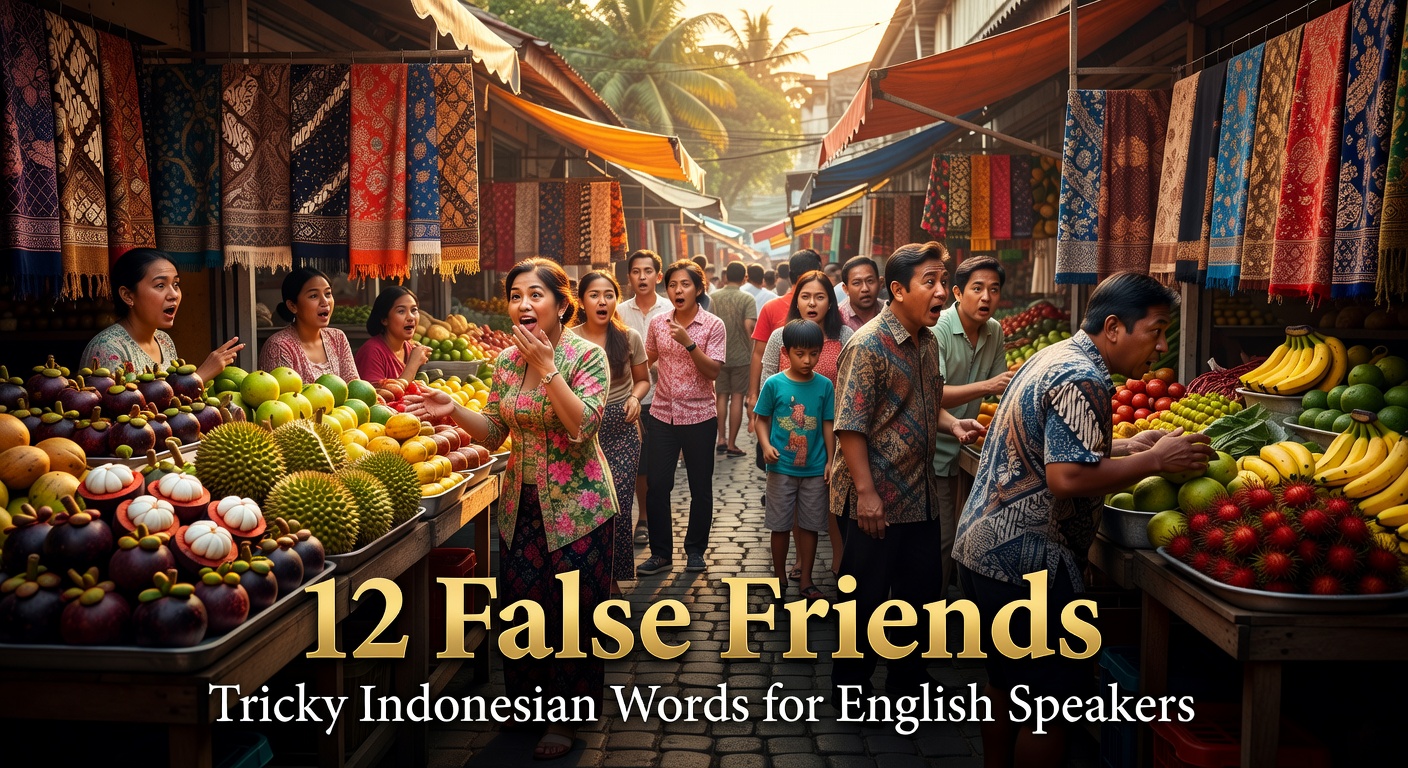
One of the sneaky joys of learning Bahasa Indonesia is how often a word looks or sounds like something familiar in English — and then means something completely different. Linguists call these false friends: words that create a false sense of recognition and trip you up right when you think you're ahead.
The good news? Once you've been burned by a false friend, you never forget it. This guide walks you through 12 of the most common Indonesian words that fool English speakers, plus a bonus section of words that actually do cross over.
1. Air ≠ Air
What you'd guess: The stuff you breathe.
What it actually means: Water.
Pronounced: "AH-eer" (two syllables)
This is probably the most startling false friend in Indonesian. Air means water — not the invisible gas surrounding you. It appears everywhere in everyday life:
- Air minum — Drinking water
- Air panas — Hot water
- Air dingin — Cold water
- Minta air, dong. — Can I get some water, please? (casual)
If you ask for air at a warung, you'll get a glass of water — which is probably exactly what you need after discovering this one.
2. Sore ≠ Sore
What you'd guess: Physically painful or tender (a sore muscle).
What it actually means: Late afternoon — roughly 3 PM to 6 PM.
Pronounced: "SOR-ay" (rhymes with "more-ay")
Indonesian divides the day into distinct named periods, and sore occupies that golden-hour slot between afternoon and evening. You'll hear it constantly in greetings:
- Selamat sore! — Good afternoon / Good evening (used in the late afternoon)
- Sampai sore. — See you in the afternoon.
- Nanti sore — Later this afternoon
The full sequence of Indonesian time-of-day greetings:
Pagi (morning) → Siang (midday/early afternoon) → Sore (late afternoon) → Malam (night/evening)
3. Jam ≠ Jam
What you'd guess: A sweet fruit spread you put on toast.
What it actually means: Clock, hour, or time.
Pronounced: "jahm" (one syllable, like "palm" without the L)
Jam is an essential everyday word for telling and asking about time:
- Jam berapa? — What time is it? (literally: "how many hours?")
- Jam tiga. — Three o'clock.
- Jam tangan — Wristwatch (literally: "hand clock")
- Satu jam — One hour
- Setengah jam — Half an hour
Interestingly, the word for the fruit spread you put on toast? That's selai in Indonesian. So if you want jam for your bread at breakfast, asking for jam will just confuse people.
4. Panas ≠ Panas (or Bread Pans)
What you'd guess: Nothing obvious in English — but sometimes English speakers see "pan" in it.
What it actually means: Hot (temperature).
Pronounced: "PAH-nahs"
Panas is one of the most useful adjectives in Indonesian, especially if you're traveling in the tropics. Indonesia is hot. Panas comes up constantly:
- Cuaca panas sekali hari ini. — The weather is really hot today.
- Air panasnya mana? — Where's the hot water?
- Hati-hati, panas! — Careful, it's hot!
- Kepanasan — Overheated / to feel too hot
Its opposite is dingin (cold). Together, panas and dingin will get you through a lot of conversations about weather, food, and water temperature.
5. Bisa ≠ Visa
What you'd guess: The travel document you need to enter a country.
What it actually means: Can / to be able to.
Pronounced: "BEE-sah"
Fun with Indonesian collects all of it — phrases, pronunciation, and culture — into one guide you can carry.
Bisa is one of the most important modal words in Indonesian. It expresses ability, possibility, and permission — all in one short word:
- Saya bisa berbicara bahasa Indonesia. — I can speak Indonesian.
- Bisa minta tolong? — Can I ask for help?
- Tidak bisa. — Can't / not possible.
- Bisa diulang? — Can you repeat that?
- Bisa bayar pakai kartu? — Can I pay by card?
For what it's worth, the actual Indonesian word for the travel document is visa — nearly identical to English, just with slightly different vowel emphasis. So you'll get that one for free.
6. Maaf ≠ Anything in English (But Sounds Like It Might Be)
What you'd guess: It sounds vaguely Arabic or perhaps like "ma'am" crossed with something else — English speakers often guess it means something rude.
What it actually means: Sorry / Excuse me / Pardon.
Pronounced: "mah-AHF"
Maaf (which does come from Arabic, via Islamic influence on the language) is one of the most socially important words you can learn. Indonesians use it to apologize, to politely interrupt, and to get someone's attention:
- Maaf, permisi. — Excuse me, sorry to bother you.
- Maaf, saya terlambat. — Sorry I'm late.
- Maaf, bisa diulang? — Sorry, can you repeat that?
- Saya minta maaf. — I apologize. (more formal, literally "I ask for forgiveness")
The phrase minta maaf (to ask for forgiveness) is the fuller, more formal version. You'll hear it in sincere apologies and formal contexts.
7. Teman ≠ Demon
What you'd guess: Something sinister — it sounds a bit like "demon" to English ears.
What it actually means: Friend.
Pronounced: "tuh-MAHN"
Nothing demonic about it. Teman is simply the everyday word for friend, and one you'll want to use early and often:
- Teman saya — My friend
- Teman lama — An old friend / longtime friend
- Teman baru — New friend
- Berteman — To be friends / to befriend
- Pertemanan — Friendship
A useful related word: teman-teman (the reduplication) means "friends" (plural) — Bahasa Indonesia often uses word doubling to indicate plurality or abundance.
8. Pintar ≠ Printer (or Anything Technological)
What you'd guess: Something to do with printing, perhaps?
What it actually means: Smart / clever / intelligent.
Pronounced: "PEEN-tar"
Pintar is a warm, frequently used adjective. In Indonesian culture, calling someone pintar is a genuine compliment:
- Anak yang pintar! — What a smart kid!
- Dia sangat pintar. — He/she is very clever.
- Pintar sekali! — So smart! / Very clever!
- Kepintaran — Intelligence / cleverness
You'll often hear pintar used encouragingly — toward children learning something new, or to compliment someone who figured out a clever solution.
9. Buku ≠ Boo (Scare Sounds)
What you'd guess: Nothing in English — or maybe something related to "book" if you squint.
What it actually means: Book.
Pronounced: "BOO-koo"
Actually, buku is a happy near-cognate! It sounds a bit like "book" stretched with an extra syllable, and it means exactly that. This one trips people up in the opposite direction — they might not trust that such a similar-sounding word could mean the same thing:
- Buku pelajaran — Textbook (literally: "lesson book")
- Buku catatan — Notebook
- Buku tamu — Guestbook
- Perpustakaan — Library (the place where many buku live)
- Toko buku — Bookstore
If you're a book lover, buku is one of your first best friends in Indonesian.
10. Keras ≠ Caress
What you'd guess: Something soft and gentle — "caress" is right there in the sound.
What it actually means: Hard, loud, or stubborn.
Pronounced: "kuh-RAHS"
The mismatch between the sound of keras (which feels soft and flowing) and its meaning (hard, rigid, forceful) is a classic false friend trap. It's actually one of the most versatile adjectives in Indonesian:
- Keras (physical): Batu ini keras. — This stone is hard.
- Keras (volume): Musik itu keras sekali. — That music is very loud.
- Keras (personality): Dia keras kepala. — He/she is hardheaded / stubborn. (literally: "hard head")
- Bekerja keras — To work hard
- Dengan suara keras — In a loud voice
Keras kepala (hardheaded) is a particularly colorful compound you'll hear often in everyday speech.
11. Bayar ≠ Buyer
What you'd guess: Someone who purchases things — a buyer.
What it actually means: To pay.
Pronounced: "BAH-yar"
Bayar is essential for any market, restaurant, or shop interaction. The confusion is understandable — a "buyer" in English is the person who pays, so the meanings orbit the same concept, just from different angles:
- Bayar di mana? — Where do I pay?
- Sudah bayar? — Have you paid yet?
- Belum bayar. — Haven't paid yet.
- Berapa yang harus saya bayar? — How much do I need to pay?
- Saya yang bayar. — I'll pay. / It's on me.
That last phrase — Saya yang bayar — is a gracious thing to say when treating someone to a meal.
12. Angka ≠ Anchor
What you'd guess: A heavy metal device that keeps ships from drifting.
What it actually means: Number / digit / figure.
Pronounced: "AHNG-kah"
The ng sound at the start is the same nasal sound as in "sing" — it's a single sound, not two separate letters:
- Angka satu — The number one
- Angka penjualan — Sales figures
- Berapa angkanya? — What's the number?
- Angka romawi — Roman numerals
Related word: nomor is also used for "number" in Indonesian, but more specifically for identification numbers — phone numbers, addresses, ticket numbers — while angka refers more to numerical digits and figures.
Words That Actually DO Cross Over (Your Freebies)
Not everything is a trap. Indonesian has absorbed a significant number of loanwords from Dutch (during the colonial period), English, and other languages — and many of them are close enough to use almost immediately. These are called cognates, and they're a genuine gift to English-speaking learners:
| Indonesian | English | Notes |
|---|---|---|
| Hotel | Hotel | Nearly identical |
| Taksi | Taxi | Slightly respelled |
| Dokter | Doctor | One letter shorter |
| Polisi | Police | Via Dutch politie |
| Telepon | Telephone | Shortened form |
| Internet | Internet | Exactly the same |
| Televisi | Television | Slightly shortened |
| Bank | Bank | Identical |
| Restoran | Restaurant | Slightly shortened |
| Kamera | Camera | Slightly respelled |
| Komputer | Computer | Slightly respelled |
| Musik | Music | Slightly respelled |
| Bisnis | Business | Slightly respelled |
| Radio | Radio | Identical |
The pattern you'll notice: Indonesian often drops silent letters and respells English words phonetically. Once you internalize that pattern, you can often guess Indonesian words for modern concepts with decent accuracy.
A Note on Why False Friends Happen
Indonesian has been influenced by many languages over its history — Sanskrit, Arabic, Portuguese, Dutch, and English most significantly. When words travel between languages, they sometimes shift meaning, narrow in scope, or collide with existing words that sound similar. That's how you end up with air meaning water and sore meaning late afternoon.
Rather than seeing false friends as frustrating, think of them as the most memorable vocabulary words you'll ever learn. The moment of surprise — wait, that means WHAT? — is exactly what makes them stick.
Encounter all of these words in real context across our lesson modules!