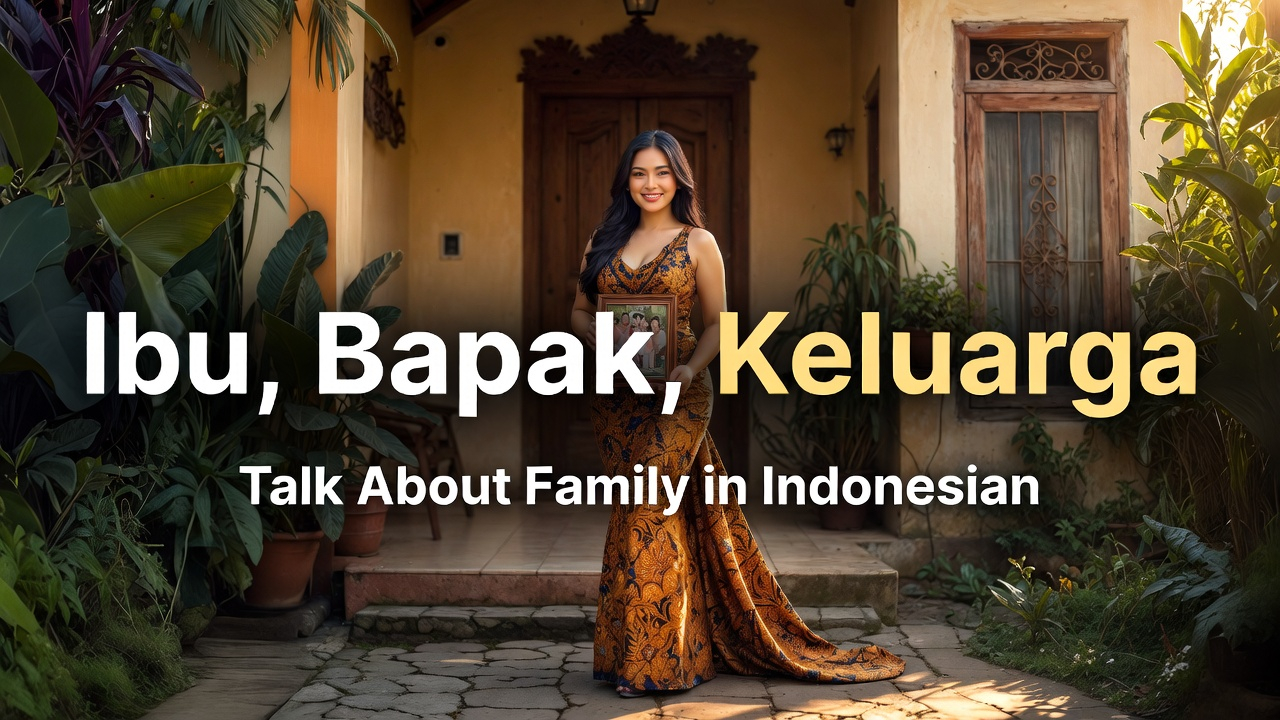
Within five minutes of meeting you, an Indonesian will ask about your family. It’s as certain as the afternoon rain during musim hujan. So let’s make sure you’re ready.
Why Family Is Everything
In Indonesian culture, family isn’t just important – it’s the foundation of identity. The question "sudah menikah?" (are you married?) isn’t small talk. It’s how Indonesians orient themselves socially. Your family status helps them understand where you are in life, how to address you, and how to relate to you.
Essential Family Words
Parents
- Ibu (EE-boo) – Mother (also used as "Mrs./Ma'am" for any woman)
- Bapak / Pak (BAH-pahk) – Father (also used as "Mr./Sir" for any man)
These words do double duty: they’re both family terms AND the standard respectful forms of address. You’ll call your hotel receptionist "Pak" and the woman at the warung "Bu" – even though they’re strangers.
Siblings
- Kakak / Kak (KAH-kahk) – Older sibling (gender neutral!)
- Adik / Dik (AH-deek) – Younger sibling (also gender neutral)
Fun with Indonesian collects all of it — phrases, pronunciation, and culture — into one guide you can carry.
These are used far beyond actual siblings. You’ll call a slightly older stranger "Kak" and a younger one "Dik" as friendly, respectful forms of address.
Spouse
- Suami (soo-AH-mee) – Husband
- Istri (ISS-tree) – Wife
Friendship
- Teman – Friend (general)
- Sahabat – Best friend / close friend
"Sahabat" carries deep weight in Indonesian culture – it implies loyalty, trust, and a bond that functions almost like family. Indonesian friendships often come with a mutual obligation to help, no questions asked.
Describing Nationality
- Orang (OH-rahng) – Person/people
- Orang Indonesia – Indonesian person
- Orang Amerika – American person
Fun etymology: the English word "orangutan" comes from Indonesian – "orang hutan" literally means "person of the forest."
Answering The Marriage Question
Here’s what will happen:
Them: "Sudah menikah?" (Are you married?)
If yes: "Sudah. Ini suami/istri saya." (Yes. This is my husband/wife.)
If no: "Belum." (Not yet.)
Never say "tidak" (no) – the word "belum" (not yet) is the culturally appropriate response, implying you will be eventually. And yes, locals may playfully try to set you up with someone. Take it as a compliment.
The Follow-Up Questions
After the marriage question comes: "Anak berapa?" (How many children?). If you have kids, talking about them is a guaranteed way to bond with anyone in Indonesia. If you don’t: "belum" works again.
The Ibu/Bapak System
Once you have children, something interesting happens in Indonesian culture: you may start being referred to as the parent of your child. If your son’s name is Adi, you might become "Ibu-nya Adi" (Adi’s mother) or "Pak-nya Adi" (Adi’s father). Your identity happily merges with your role as a parent.
Learn all the family vocabulary with native pronunciation in our Family & People module!