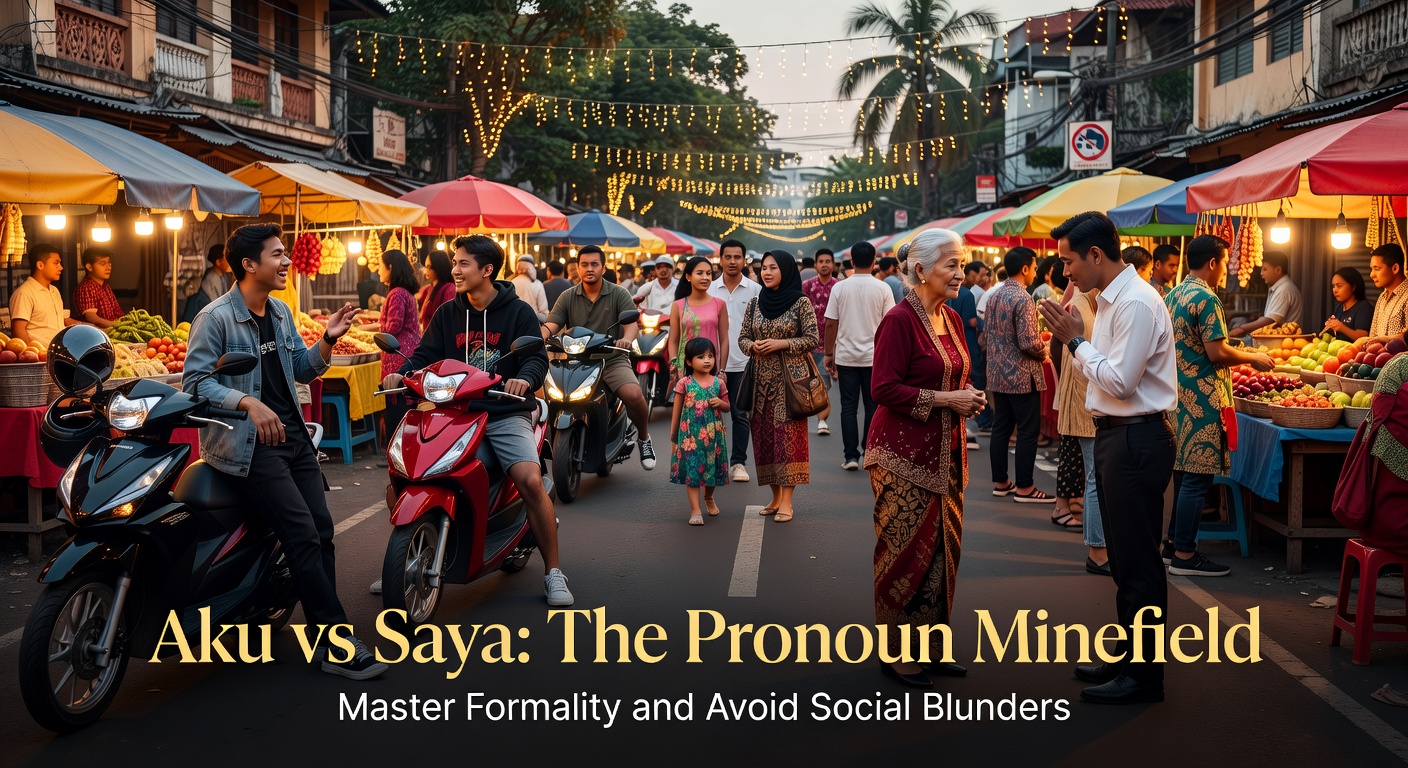
Aku vs Saya, Kamu vs Anda: The Indonesian Pronoun Minefield
In English, "I" is always "I" and "you" is always "you." Simple, right? But in Indonesian, it's like stepping into a vibrant cultural dance where the words you choose for "I" and "you" can make or break the mood. Don't worry—it's not as scary as it sounds! Indonesian pronouns are all about showing respect, building connections, and navigating social hierarchies, which makes learning them a fun adventure. As you dive into Bahasa Indonesia on our site, you'll see how mastering these can turn awkward exchanges into smooth, engaging conversations. The rules might feel tricky at first, but once you get the hang of it, you'll sound like a natural. And remember, even native speakers appreciate when learners put in the effort—it's a great way to make friends!
This guide will help you navigate the pronoun minefield, drawing from the lessons in our modules. For more on basic greetings and introductions, check out Lesson 3.1. Let's break it down step by step, starting with words for "I" and "me."
Words for "I" / "Me"
Indonesian offers a rainbow of options for "I," each colored by the level of formality and your relationship with the listener. This reflects Indonesia's rich cultural tapestry, where respect for age, status, and familiarity is key. Choosing the right one isn't just about grammar—it's about social harmony. Let's explore each option with more examples, pronunciation tips, and practical advice to help you use them confidently.
Saya — The Safe Default
Register: Polite / formal / neutral
Use with: Strangers, elders, bosses, anyone you've just met, or in formal settings like job interviews or official emails
Saya is your trusty sidekick in the world of Indonesian pronouns—always polite and never out of place. It's like the Swiss Army knife of words: versatile and reliable. Pronunciation-wise, it's straightforward: say it as "SAH-yah," with the emphasis on the first syllable.
For instance, instead of saying, "I am from America," you might say, "Saya dari Amerika." (Translation: I am from America. Pronunciation: SAH-yah DAH-ri Ah-meh-REE-kah.) This works perfectly when introducing yourself at a business networking event or chatting with a taxi driver.
Culturally, "saya" embodies the Indonesian value of hormat (respect), which is deeply rooted in the country's diverse traditions. In a society where hierarchy matters—think of the respect shown to elders in Javanese culture—starting with "saya" shows you're mindful of boundaries. A practical tip: Use it in professional emails or when ordering at a restaurant, like "Saya ingin pesan nasi goreng." (I would like to order fried rice. Pronunciation: SAH-yah IN-gin peh-SAN nah-see goh-RENG.)
Common mistake to avoid: New learners might overuse "saya" everywhere, which can make you sound overly distant with friends. But hey, it's better to be too polite than not polite enough! As you progress, check out Lesson 9.1 for more on formal communication to refine your skills.
Aku — The Casual One
Register: Informal / intimate / casual
Use with: Close friends, romantic partners, people your age in relaxed settings, or children
Aku brings a warm, friendly vibe—it's like swapping stories with your best buddy over street food in Jakarta. Pronounce it as "AH-koo," with a short, punchy sound. This pronoun pops up in everyday chats and even in Indonesian pop songs, making it feel approachable and fun.
For example, you could say to a friend, "Aku lapar nih!" (I'm hungry! Pronunciation: AH-koo LAH-par nee.) Or in a romantic context, "Aku rindu kamu." (I miss you. Pronunciation: AH-koo REEN-doo KAH-moo.) Imagine you're at a beach hangout with pals; using "aku" here strengthens bonds and shows you're part of the group.
Fun with Indonesian collects all of it — phrases, pronunciation, and culture — into one guide you can carry.
From a cultural perspective, "aku" highlights Indonesia's emphasis on kekeluargaan (family-like closeness). In places like Bali or among younger crowds in big cities, it's common in casual settings, but using it with someone older could come across as disrespectful, like calling your teacher by their first name in English. Practical usage scenario: If you're playing games with kids, try "Aku menang!" (I win! Pronunciation: AH-koo muh-NANG.) To avoid mistakes, don't drop "aku" on acquaintances—start with "saya" and switch once you're invited into that inner circle. For deeper dives, Lesson 3.2 covers casual conversations that feature "aku" beautifully.
Gue / Gua — Jakarta Slang
Register: Very casual / Jakarta youth culture
Use with: Close friends, especially in urban areas like Jakarta, or with people who share that slang
Gue (or its variation gua) is the cool, edgy pronoun from Betawi culture that's taken over Jakarta's streets and social media. Pronounce it as "goo-EH," and it's often paired with "lo" for "you." This isn't just slang—it's a badge of belonging in Indonesia's youthful, fast-paced scenes.
A real-life example: With your Jakarta buddies, you might say, "Gue mau ke mall nih." (I'm going to the mall. Pronunciation: Goo-EH mah-oo kuh mall nee.) It's perfect for informal WhatsApp chats or hanging out at warungs (street food stalls).
Culturally, "gue" reflects the dynamic, multicultural vibe of Jakarta, blending influences from Chinese, Dutch, and local dialects. It's popular in youth media, like Indonesian YouTube videos, but using it in formal settings could make you sound unprofessional, similar to slang in a job interview back home. A practical tip: Stick to this with peers who use it first—it's like an inside joke. Common mistake: Non-Jakartans might adopt it too quickly and seem inauthentic; always gauge the context. If you're exploring slang further, Lesson 9.2 has great examples from urban Indonesian life.
Words for "You"
Just as with "I," Indonesian has a variety of words for "you," each tailored to the relationship and setting. This is tied to Indonesia's collectivist culture, where maintaining harmony (gotong royong) is essential. Let's unpack these with more scenarios, insights, and tips to help you choose wisely.
Anda — The Formal One
Register: Formal / polite / distant
Use with: Written language, business meetings, official settings, or people you don't know well
Anda is the polished pronoun we emphasize in our lessons—think of it as your formal suit for language. Pronounce it as "AHN-dah." It's ideal for resumes, emails, or addressing customers, like "Anda bisa membantu saya?" (Can you help me? Pronunciation: AHN-dah BIH-sah mem-BAN-tu SAH-yah.)
In cultural terms, "anda" underscores respect in hierarchical societies, such as in government or corporate environments. However, many Indonesians prefer avoiding pronouns altogether by using titles, which we'll cover soon. Practical scenario: In a hotel, you might say, "Anda punya kamar kosong?" (Do you have an empty room? Pronunciation: AHN-dah POO-nyah KAH-mar ko-SONG.) Mistake to avoid: Overusing it in casual talks can feel stiff, so save it for professional contexts. For more on formal interactions, link up with Lesson 2.6.
Kamu — The Friendly One
Register: Casual / friendly / intimate
Use with: Friends, romantic partners, people your age, or children
Kamu is the go-to for warm, everyday interactions—pronounce it as "KAH-moo." It's like a high-five in word form! For example, "Kamu mau pergi ke mana?" (Where do you want to go? Pronunciation: KAH-moo mah-oo PUR-gee kuh MAH-nah.) Use this with pals planning a weekend trip or in flirty chats.
Culturally, "kamu" fosters closeness in Indonesia's community-oriented society, but it's a no-go with elders, as it might seem presumptuous. Practical tip: In family settings, like talking to siblings, "Kamu sudah makan?" (Have you eaten? Pronunciation: KAH-moo SUH-dah MAH-kan.) is spot-on. Common error: Learners often mix it up with "anda" in informal spots, which can cool things down—always match the energy of the conversation.
Lo / Lu — Jakarta Slang
Register: Very casual
Use with: In the same laid-back contexts as "gue," like with Jakarta friends
Lo (or lu) pairs perfectly with "gue" in slang-heavy chats—pronounce it as "loh." An example: "Lo udah nonton film itu?" (Have you watched that movie? Pronunciation: Loh oo-dah NON-ton film EE-too.) It's great for casual banter online or at hangouts.
This slang echoes Jakarta's vibrant street culture, but it's context-specific. Tip: Use it sparingly as a learner to avoid sounding forced. For cultural insights and more examples, revisit the sections on "gue."
Understanding Formality and Cultural Insights
To tie it all together, Indonesian pronouns are deeply linked to social etiquette, influenced by the country's diverse ethnic groups like Javanese and Sundanese traditions. Formality isn't just about words—it's about budaya (culture). A quick comparison table can help:
| Pronoun Type | Formality Level | Best For | Potential Pitfall |
|---|---|---|---|
| Saya / Anda | High | Strangers, professionals | Sounds distant in casual settings |
| Aku / Kamu | Medium | Friends, peers | Can feel rude with elders |
| Gue / Lo | Low | Youth slang | May confuse outsiders |
The Title Workaround
As mentioned, Indonesians often sidestep pronouns by using titles, which is a clever way to show respect without awkwardness. This practice stems from a culture that values indirect communication to maintain harmony. For example, instead of "Kamu suka makanan apa?" (What food do you like?), say "Mbak suka makanan apa?" (What food do you like, miss? Pronunciation: M'bak SOO-kah mah-KAH-nan AH-pah.) It's polite and natural!
Practical scenario: At a market, use "Pak, berapa harganya?" (Sir, how much is it? Pronunciation: Pahk, buh-RAH-pah HAR-gah-nya.) This avoids any formality slip-ups and makes interactions smoother.
The Cheat Sheet
| Situation | "I" | "You" |
|---|---|---|
| Meeting someone new | Saya | Pak/Bu or Anda |
| Business meeting | Saya | Bapak/Ibu |
| With close friends | Aku | Kamu |
| Romantic partner | Aku | Kamu or Sayang |
| With children | Aku or Kakak | Adik or Dik |
| Jakarta slang | Gue | Lo |
| Safest default | Saya | Pak/Bu |
The Beginner Rule
When in doubt, stick with "saya" for yourself and titles like Pak/Bu for others—you'll always sound polite and in tune with Indonesian social dynamics. As you build confidence, experiment with aku and kamu in safe settings, and dive into our modules on grammar and etiquette. Start with the Introductions module today, and watch your conversations flourish!